|
| menu | |
| search | |
| forums | |
| resources | |
| |
 | Updating Website |
 Our host did some upgrading, which required us to do some upgrading. Please be patient as we clean things up. So far I notice Genderberg Resources is not working. The public forum may have what you're looking for http://genderberg.com/boards/viewforum.php?f=10 , or if you have a question, contact me at sam {at} Genderberg{dot}com
Last updated 4-21-2014 Our host did some upgrading, which required us to do some upgrading. Please be patient as we clean things up. So far I notice Genderberg Resources is not working. The public forum may have what you're looking for http://genderberg.com/boards/viewforum.php?f=10 , or if you have a question, contact me at sam {at} Genderberg{dot}com
Last updated 4-21-2014
|
|
|
Posted by p2r9s on Monday, April 21 @ 22:38:55 EDT (3719 reads)
Read More... | Score: 0
|
|
|
| News: New research shows violence decreases under Nordic model: Why the radio silence? |
 published at Feminist Current January 22, 2013
You probably haven’t heard about the newest prostitution research from
Norway. It has been available in Norwegian since last summer when a tiny
handful of pro-prostitution peeps
wrote about it, but almost no one has noted the report’s English
release. Now that I’ve read it I understand the silence from pro-sex
work lobbyists and the liberal media that usually loves press releases
that hate on anti-pornstitution activists.
“Dangerous Liaisons: A report on the violence women in prostitution are exposed to” was presented to me as proof that criminalizing johns has increased violence against prostitutes in Oslo. Norwegian newspaper The Local reported on the research and dutifully presented the results highlighted by the harm reduction researchers at ProSentret.
“Anniken Hauglie (Conservative Party) called for the law
to be scrapped after the city’s official help centre for prostitutes,
ProSentret, released a report on Friday detailing deteriorating
conditions for sex workers in the capital.
‘The reality is that the law has made it more difficult for women in prostitution,’ Hauglie said.”
The 2012 research is compared to 2008 research and the conclusion
drawn is that in 2008 52% of prostitutes in Oslo said they had
experienced violence compared to 59% in 2012. An increase of 7% isn’t a
huge jump but any increase in violence against women should be taken
seriously.
Fortunately, the increase in violence against prostituted women is a lie.
LIARS!
Several obfuscations and omissions were employed to concoct the lie,
but the primary manipulation was accepting a definition of violence that
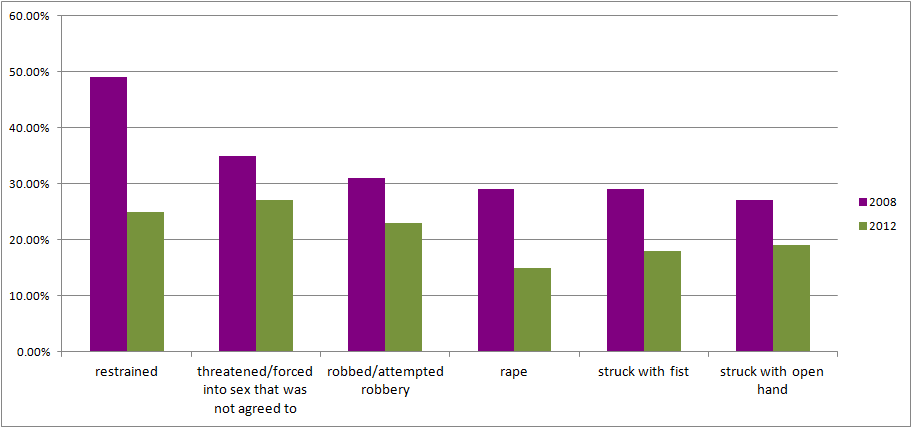
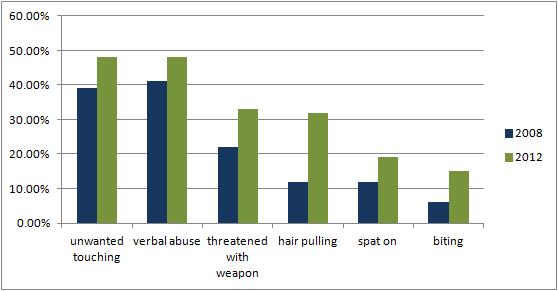
equated each act of verbal abuse (up 17% from 2008) and hair pulling
(up 167%) the same as being struck with a fist (down 38%) and rape (down
48%).
Did I just write that since the Nordic model rapes of prostituted women were down BY HALF in Oslo? Oh yes I did.
ProSentret did not consider the halving of rape to be worth pointing
out, but I think that’s terrific news. I also think that pimp violence
being down BY HALF since 2008 should be shouted from the rooftops along
with violence from regular clients going down 65% and violence from an
unfamiliar man in a car declining 60%.
Visible injury has decreased from a third of the sample to a fourth.
One thing that has changed is that the number that experienced
violence from someone unfamiliar in a car has declined from 27% to 11%.
We also see a decline in violence from regular clients from 20% to 7%, and 14% to 7% from boss/pimp.
With the dramatic reductions in serious violence within the research
you might be wondering from whence came the claimed 7% rise. The answer
is mostly verbal harassment and minor physical assaults because no
distinction is made between nasty words and being punched.
Harm reductionists love to thump about how indoor prostitution is
safer than streetwalking, and in some aspects it is, but the research
paints a contrary picture about indoor violence. Feminists have been on a
long mission to raise awareness that women are more often attacked in
their homes by men they know than in public by strange men. Why would
being in a brothel with a john suddenly become a place to expect less
rape when inside is never safer for women?
The research supports the known feminist truth of how women are
harmed when trapped indoors with men engorged on their perceived right
to control women. The most violent men are “unfamiliar clients” and the
women they inflict the worst sexual violence on are the indoor Thai
women, also the only group to report violence from pimps (11%).
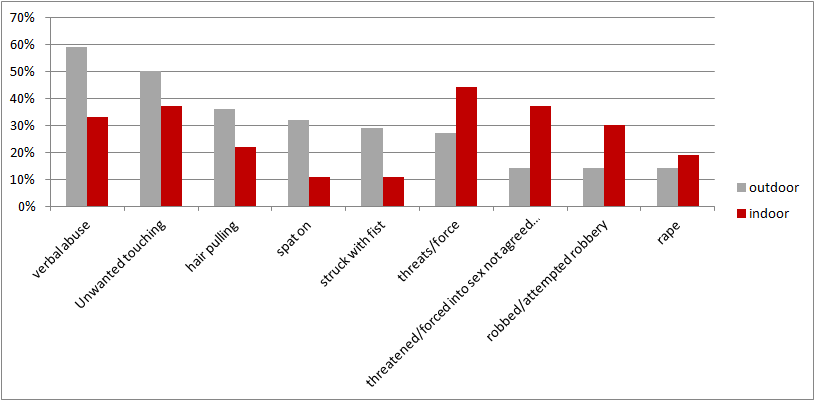
In this group we find the largest amount of respondents
who say they have been threatened/forced into sex that was not agreed
to. While 27% of the entire sample said they had been exposed to this
form of violence, as many as 45% of this group have experienced it. In
this group we also see the highest amount of robbery (30%) and threats
with weapons (40%) Additionally 20% of this group said they had been
raped.
Indoor prostitutes are being sexually assaulted by their clients more
than streetwalkers, who are ultimately abused more frequently but not
raped or robbed more.
The information about indoor versus outdoor violence also disproves
the common refrain that because it’s now a “buyer’s market” prostituted
women are harmed by the lack of negotiation time. Streetwalkers mostly
suffer verbal abuse and minor physical assaults that aren’t violations
of sex act negotiations, whereas indoor prostitutes with the supposed
luxuries of pre-screening and unlimited time to negotiate are much less
capable of keeping their johns from robbing, raping, and
threatening/forcing them into sex that was not agreed upon.
Placing all the focus on how prostituted women negotiate distracts us
from questioning the varying motivations of negotiation-inducing men.
It is common sense that a man who wants a quick blowjob from a
streetwalker would be less invested financially and emotionally in his
sexual entitlement to a prostitute than a man who pre-arranges to pay
for an hour alone with a prostitute and brings a sixty minute gameplan
of fantasy fulfillment with him.
BITERS!
Allow me to turn your attention to some freaky shit you might have missed in the statistics tsumani above:
Biting nearly tripled (6% to 15%)
Hair pulling nearly tripled (12% to 32%)
I’ve lived in New York City and San Jose, Costa Rica, which is to say
I’ve been verbally harassed and suffered unwanted touching from
unfamiliar male passerby more times than I can count. Never have I been
bitten or had my hair pulled. That’s not passerby harasser behavior,
it’s john behavior. Information originally reported in the 2008 study
but repeated in the 2012 report provides a clue to why minor, sex
act-specific violence jumped.
“Most of the women who said they would seek help to
protect against violence said that they called or threatened to call the
police when they found themselves in a dangerous or threatening
situation. This would often scare the customers, or others, who were
acting threatening/violent away.”
Pro-prostitution lobbyists say men are paying for the right to sex
and not the right to abuse women. Johns don’t exhibit an understanding
of that difference, which is why letting men pay for sex and then trying
to draw a line at abuse is doomed to failure. Men paying for the right
to abuse women have crossed that line, no takesees-backsees halfway
through the series of abuses paid for, especially not when BDSM
inflicted on women is culturally approved as sex and not abuse.
Radical feminists know prostitution is coerced sex, aka rape. We
notice that most rape victims are teenage girls abused by older men and
recognize the same demographic patterns in prostitution. As with rape,
the sexual aspect of the crime triggers so many cultural prejudices that
the core of the crime being male violence is often left on the cutting
room floor. Oslo’s reduction in severe violence combined with the
increase in more personal boundary violence like biting and hair pulling
is a reminder that, as with other kinds of rape, sex is the preferred
tool of violation but violation itself is the main point.
Prostituted women in Oslo are effectively altering violent johns’
behaviors by threatening to call police, and johns are responding by
lowering their violence to under the threshold that would trigger that
response. Instead of rape and aggravated assault, johns have moved to
getting more of their violation kicks though biting and hair pulling
knowing these won’t result in a call to the cops.
On that note, let’s segue into what the report tells us about police and prostitutes.
COPPERS!
Police abuse of prostituted women is a problem. Some studies have found
that as much as 30% of violence against prostituted women can come from
police officers. Police abusiveness is frequently cited by harm
reductioners as a reason to legalize men’s prostitution use. ProSentret
makes a big deal of the fact that prostituted women are reporting less
violence because they claim it as a consequence of prostitutes trusting
police less, but it’s more accurately attributed to the large drop in
severe violence.
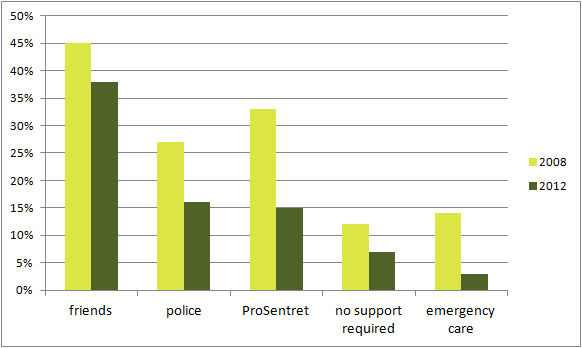
“If we look at assistance from police, emergency care,
Pro Sentret, and Nadheim, we see approximately half the number that
have received support in the 2012 study compared with the 2007/08
study.”
Approximately half the number receiving support matches up quite well
with rape being down by half and pimp violence being down by half.
According to their own numbers, since adoption of the Nordic model
prostitutes are 41% less likely to seek help from police, but they are
54% less likely to seek help from ProSentret! And apparently prostituted
women are suddenly terrified of emergency care personnel because
seeking help from them is down a whopping 79%.
If you don’t acknowledge the enormous reductions in severe violence
then these changes are as alarming as ProSentret makes them out to be.
Combined with street prostitution going down at least 50% from 2008 to 2009 and indoor prostitution going down by 16% in the same year, the sharp drop in prostituted women reporting violence is actually something to celebrate.
ProSentret’s ideological constipation won’t allow them to admit the enormous reduction in severe violence their data shows.
“Many of the women’s actions are probably due to a fear
of prejudice from the police, the justice system, and health services.
The double stigma as both victim of violence and prostitute can be a
heavy burden to bear. Other reasons could be among other things a lack
of knowledge of the police and reporting violence in Norway, fear that
the police will enforce other laws against the prostitute, a lack of
trust in the police, or that the women for some other reason does not
wish to press charges.”
Persons who make police abuse of sex workers their bailiwick may find
it instructional that none of the violence reported by the 123
prostituted women was pinned on Norwegian police, not so much as one
instance of verbal abuse. Score yet another point for the Nordic model.
Rarely does a group of pro-prostitution activists make their choice
to be ignorant so evident as to ignore the data from their own research.
Mind you, it’s not unheard of; New Zealand research collected by the
prostitution lobby claimed no changes to street prostitution in their
official summary but buried in Section 8 one finds the truth that street prostitutes in Auckland more than doubled since legalization.
It is a bald lie to take the information presented in “Dangerous Liaisons” and come to this conclusion:
“Nothing in the studies we have conducted among the women
and the support services suggests that the criminalization of the
customers have protected the women from violence from their customers,
rather the women are protecting the customers from the police.”
ENDERS!
The final words of the report declare:
This will be done by the Pro Sentret:
• Organize drop-in courses about violence in prostitution and
violence in close relations with a focus on knowledge about violence,
practical tips and information about offers of aid. The courses will be
organized in cooperation with Oslo Crisis Center and a provider of
self-defense courses.
• Work out and distribute information material adapted to the users
of Pro Sentret about violence, rights, and tips about maintaining their
own safety.
In other words, ProSentret’s goal is to build better hookers. I prefer other solutions.
The Nordic model works and should keep on keeping on. If ProSentret
and other sex worker rights groups refuse to get on board the abolition
of sex-based slavery they’re fools, but they’re fools who can still be
doing more for prostituted women from within their belief system.
The first thing they can do is actively track prostitution clients
more effectively. Unfamiliar clients commit the most violence and
passively relying on bad date reports from survivors of john violence is
not enough. There’s room for both police and nonprofits to be
collecting information about unfamiliar johns in their own way.
Next they can work to achieve reliable amnesty for foreign victims. I
am unfamiliar with how Norway treats trafficked immigrants but I have
no trouble believing more can be done to protect them from
discrimination and deportation.
My third and final suggestion is for harm reduction organizations to teach prostituted women that any
violence inflicted on them matters. Biting and hair pulling have almost
tripled but reporting them hasn’t. Johns will be as violent as they can
get away with so we need to keep pushing back the bar of acceptability.
Credit where due, the researchers sincerely attempted to honor
prostituted women’s psychological defenses by distinguishing the
categories of “rape” and “threatened/forced into sex that was not agreed
upon” in recognition that many don’t call it rape if there’s no assault
accompanying the sexual violence. They include this comment about
cultural differences in defining violence.
“Pro Sentret have experienced that in general many
foreign women express both physical and psychological pain differently
than Norwegian women. It is possible that some did not recognize their
way to express pain in the options in the study.”
It’s obvious the researchers at ProSentret care about the women they
serve, I just wish they could project that concern to the millions of
women they will never see and the generations of prostitutes that will
come after the current one if we don’t take a stand now.
Like I said in the beginning, the Oslo research has barely made a
blip in pro-prostitution media channels. The usual loudmouthed
prostitution lobbyists have seen it and kept their lips zipped. You
better believe if the report contained solid proof that the Nordic model
leads to more violence then it would be as popularized as that bunk
study purporting career pornstitutes are happier than the average woman.
Now you know about it, and now you know why the prostitution lobby
prefers to pretend it doesn’t exist.
It exists and it proves abolitionists right. Now don’t let them forget it.
|
|
|
Posted by smberg on Wednesday, June 12 @ 13:19:54 EDT (4348 reads)
Read More... | News | Score: 0
|
|
|
| News: |
 The Irish Examiner The Irish Examiner
Wednesday, February 15, 2012
A
former Dublin prostitute speaks about her seven years working in the
Irish sex trade and argues against the idea that legalisation can make
the work any safer
FOLLOWING the latest revelations about
Ireland’s booming prostitution rackets, a former Dublin prostitute has
written a stark account of her seven year ordeal in the industry which
began when she was just 15.
At that young age, circumstances no
child should ever experience forced her to sell her body to elderly men,
who would openly be aroused by abusing a child. Before she managed to
extricate herself from a life in which she says she was "raped for a
living", she admits she even contemplated suicide...
"The nation
is finally beginning to take a look at the intrinsic harm of
prostitution. I welcome this because it is a harm I have understood
since I was a 15-year-old prostitute, being used by up to 10 men a day.
The one thing that linked those men together, besides their urges to pay
to abuse my young body, was that they all knew just how young I was.
They all knew because I told them, and I told them because it had the
near-universal effect of causing them to become very aroused.
"When
a man is very aroused in street prostitution that is a good thing,
because it means he’ll climax quickly and the whole ordeal will be over
fairly fast. I learned that on my very first day while sitting in the
car of an elderly man who repeated over and over the thing that was
causing him such sexual joy: ‘Oh, you’re very young — aren’t you? Aren’t
you?’
"That is the true, sleazy and debased face of prostitution
— the face that pro-prostitution lobby groups hysterically deny and
attempt to conceal. Well, they cannot conceal it from me. I spent too
long looking at it, too long being abused by it, and too long trying to
recover from the soul-level injury it left behind.
"Many of the
girls I worked alongside were not much older than I was, and one was
only 13-years-old — and there was no shortage of grown men paying to
abuse her. Most of the older women had been working since they were our
age or younger, and many of them had histories of sexual abuse that
predated their prostitution lives. When a person looks at a 30- or
40-something prostitute what they forget is that they are looking, in
most cases, at a woman who has been inured to bodily invasion since she
was a prepubescent child.
"I didn’t just work outdoors. When the
Sexual Offences Act of 1993 came into force it drove me and many others
indoors, where we had even less autonomy over the conditions of our own
lives. In the brothels and the ‘escort’ agencies, we had to endure the
same things we did on the streets, but we had to endure them for longer,
and with no screening process as to who would pay to abuse us.
"You
might wonder, ‘if you were a prostitute, what did it matter who it
was?’ That is an innocent question, and it is deserving of an answer. It
mattered because, far from being unaware of the abusive nature of
prostitution, a lot of men were not only aware of it but actively got
off on it. The misogyny from a lot of men was so potent and so
deliberate it could cause nothing but trauma. And we, as the prostituted
class that we were, could do nothing to protect ourselves other than
try to avoid its most potent manifestations. This had been at least
somewhat possible on the streets, where we could do our best to discern
whether or not a man had hatred and the desire to hurt us seeping out of
every pore. It was not at all possible once we’d gotten run indoors,
and the immediate effect was a rapid escalation in violence and murder.
"Irish
prostitution has been mainly conducted indoors since then, and nothing
about this ugliness has abated because it’s been concealed from the
public view. In fact the opposite has been true. We were abused more
thoroughly, not less, with the only difference being that now there was
the secrecy of closed doors to conceal it.
"There is no doubt
that many of these men had daughters older than I was, yet the abuse
they unleashed on me was devastating, violent, humiliating and
degrading. It was paid sexual abuse. It was ritualistic, and I
experienced it in every area of prostitution.
"Do not for a
moment think that the men paying to abuse here are not ‘ordinary men’. I
could not count the number of wedding rings and babies car seats I
encountered. The men who pay to debase and degrade women and girls in
prostitution are the same men who play out the pretence of being happily
married family men. I wonder sometimes at the amount of women who would
be shocked, not only to know their husbands are visiting prostitutes,
but also to know the depth of their own husbands’ contempt and
misogynistic hatred of women.
"Under Irish law, the abusive
nature of prostitution has been allowed to flourish unhindered and it is
a living hell for the women struggling to survive within it. It is
primarily for the sake of these women, but also for all of us who want
to live in a gender-equal society, that I am gladdened to see the Irish
Government finally pledge to tackle this issue.
"I only hope that
they go the right way about it, which is to criminalise the purchase of
sex, because nothing will change for prostituted women and girls until
the commercialisation of female bodies is dealt the hammer-blow it so
richly deserves.
"To those who would say legalisation would make
prostitution safer: I think the same thing any former prostitute I’ve
ever spoken to thinks, which is that you may as well legalise rape and
battery to try to make them safer. You cannot legislate away the
dehumanising, degrading trauma of prostitution, and if you try to, you
are accepting a separate class of women should exist who have no access
to the human rights everyone else takes for granted."
|
|
|
Posted by SMBerg on Friday, March 02 @ 11:07:27 EST (4815 reads)
Read More... | News | Score: 5
|
|
|
| News: Sex Trafficking of Americans: The Girls Next Door |
 Sex Trafficking of Americans: The Girls Next Door Sex Trafficking of Americans: The Girls Next Door
Vanity Fair
Even
as celebrity activists such as Emma Thompson, Demi Moore, and Mira
Sorvino raise awareness about commercial sex trafficking, survivor
Rachel Lloyd publishes her memoir Girls Like Us, and the Senate
introduces a new bipartisan bill for victim support, the problem
proliferates across continents, in casinos, on streets, and directly
into your mobile device. And, as Amy Fine Collins shows, human
trafficking is much closer to home than you think; victims, younger
than ever, are just as likely to be the homegrown American girl next
door as illegally imported foreigners. Having gained access to victims,
law-enforcement officials, and a convicted trafficker, Collins follows
a major case that put to the test the federal government’s Trafficking
Victims Protection Act.
The
names of all victims and their relatives have been changed. Quotes from
Dennis Paris, Gwen, and Alicia are taken from court testimony.
“He
called me a stupid bitch … a worthless piece of shit.… I had to tell
people I fell off stage because I had so many bruises on my ribs face
and legs.… I have a permanent twitch in my eye from him hitting me in
my face so much. I have none of my irreplaceable things from my youth.”
—From the victim-impact statement of Felicia, minor prostitute-stripper enslaved by trafficker Corey Davis.
“Prostitution is renting an organ for ten minutes.”
—A john, interviewed by research psychologist Melissa Farley.
“Would
you please write down the type of person you think I am, given all that
you’ve heard and read?… I’ve been called the worst of the worst by the
government and it’s going to be hard for you to top that.”
—Letter
postmarked June 27, 2008, to Amy Fine Collins, from Dennis Paris,
a.k.a. “Rahmyti,” then inmate at the Wyatt Detention Facility, in
Central Falls, Rhode Island, now at a high-security federal
penitentiary in Arizona.
The Little Barbies
In
the Sex Crimes Bureau of the Brooklyn District Attorney’s Office, in
the pediatric division of Fort Bragg’s Womack Army Medical Center, in
the back alleys of Waterbury, Connecticut, and in the hallways of
Hartford’s Community Court, Assistant D.A. Rhonnie Jaus, forensic
pediatrician Dr. Sharon Cooper, ex-streetwalker Louise, and Judge
Curtissa Cofield have all simultaneously and independently noted the
same disturbing phenomenon. There are more young American girls
entering the commercial sex industry—an estimated 300,000 at this
moment—and their ages have been dropping drastically. “The average
starting age for prostitution is now 13,” says Rachel Lloyd, executive
director of Girls Educational and Mentoring Services (gems), a
Harlem-based organization that rescues young women from “the life.”
Says Judge Cofield, who formerly presided over Hartford’s Prostitution
Protocol, a court-ordered rehabilitation program, “I call them the
Little Barbies.”
The explanations offered for these downwardly
expanding demographics are various, and not at all mutually exclusive.
Dr. Sharon Cooper believes that the anti-intellectual, consumerist,
hyper-violent, and super-eroticized content of movies (Hustle &
Flow), reality TV (Cathouse), video games (Grand Theft Auto: Vice
City), gangsta rap (Nelly’s “Tip Drill”), and cyber sites (Second Life:
Jail Bait) has normalized sexual harm. “History is repeating itself,
and we’re back to treating women and children as chattel,” she says.
“It’s a sexually toxic era of ‘pimpfantwear’ for your newborn son and
thongs for your five-year-old daughter.” Additionally, Cooper cites the
breakdown of the family unit (statistically, absent or abusive parents
compounds risk) and the emergence of vast cyber-communities of
like-minded deviant individuals, who no longer have disincentives to
act on their most destructive predatory fantasies. Krishna Patel,
assistant U.S. attorney in Bridgeport, Connecticut, invokes the easy
money. Criminals have learned, often in prison—where “macking” memoirs
such as Iceberg Slim’s Pimp are best-sellers—that it’s become more
lucrative and much safer to sell malleable teens than drugs or guns. A
pound of heroin or an AK-47 can be retailed once, but a young girl can
be sold 10 to 15 times a day—and a “righteous” pimp confiscates 100
percent of her earnings.
read the rest at http://www.vanityfair.com/politics/features/2011/05/sex-trafficking-201105
|
|
|
Posted by SMBerg on Tuesday, June 14 @ 13:46:04 EDT (52896 reads)
Read More... | News | Score: 0
|
|
|
| News: Prostitution, abolition of victims, and postmodernist defence of the status quo |
 Prostitution, the abolition of the victim, and post-modernism's defence of the status quo Prostitution, the abolition of the victim, and post-modernism's defence of the status quo
Posted by Stuart at Scottish Socialist Youth on September 25, 2010
http://ssy.org.uk/2010/09/prostitution-the-abolition-of-the-victim-and-post-modernisms-defence-of-the-status-quo/#comments
I’ve just finished reading a book by the Swedish socialist,
anarchist and feminist Kajsa Ekis Ekman which she primarily devotes to
debunking the arguments used to justify prostitution and the
surrogate-mothering industry. Her book was written as a response to the
media’s misrepresentation of prostitution as some sort of smart and
glamorous career choice for young women to make and at the increasing
number of post-modernist academics and ‘queer-theorists’ who have been
questioning Sweden’s prostitution laws by, among other things,
ludicrously trying to frame prostitution as something ‘transgressive’
and which ‘challenges gender norms’.
The abolition of the victim
Ekis Ekman highlights at length the tactics which the
supporters of prostitution have adopted in recent years and exposes how
false, absurd and damaging their arguments really are. Particularly
interesting I think is when she writes about the attempts that have
been made to abolish the term ‘victim’ from the debate around
prostitution. To be a victim has come to be seen as something shameful
and to refer to someone as a victim is, according to the
post-modernists, to deny them their ‘agency’. Ekman exposes why this
lie has come about and what wider political consequences it has. Her
point here is summed up in a review of the book in Dagens Nyheter:
“To be able to defend that women sell their bodies
(and that men buy them) one must first abolish the victim and instead
redefine the prostitute as a sex worker, a strong woman who knows what
she wants, a businesswoman. The sex worker becomes a sort of new
version of the ‘happy hooker’.
“Ekis Ekman shows in a convincing way how this happens through
a rhetoric which portrays the victim position as a trait of character
instead of using the correct definition of a victim: someone who is
affected by something. In such a way the terrible reality in which
women in prostitution find themselves is concealed. The fear of the
‘victim’ in the prostitution debate … is something which mirrors
neo-liberalism’s general victim hate – since all talk of the vulnerable
person immediately reveals an unjust society. Through making the victim
taboo can one legitimise class inequalities and gender discrimination,
for if there is no victim there is no perpetrator.”
Those who defend prostitution, as Ekis Ekman points out in an
interview in the socialist newspaper Flamman, “have a contempt for
weakness, a cold and cynical view of humanity, which has the
consequence that you only have yourself to blame”.
To see evidence of this we need look no further than the works
of ‘academics’ such as Laura Agustin, someone who has gone as far as to
deny the existence of human trafficking. Victims of pimps and human
traffickers are referred to, in her language, as “migrant sex workers”
who actively choose their situation. Discussing women brought into
western countries by criminal gangs and locked into flats and
prostituted for months at a time, Agustin writes:
“These circumstances where women live in sex
establishments and seldom leave them before, without being asked, moved
elsewhere receive great attention in the media and it’s taken as a
given that this involves a complete denial of freedom. But in many
cases migrant workers prefer this arrangement for a number of reasons.
If they don’t leave the area they don’t waste any money and, if they
have no work permit, they feel safer in a controlled environment. If
someone else finds the meeting places for them and books their
appointments it means they don’t have to do it themselves. If they have
come on a 3 month tourist visa they want to devote as much time as
possible to making money”.
Another sickening example from Ekman’s book is that in
Australia, a country which has long championed legalised prostitution,
victims of child abuse have came to be referred to as “child sex
workers”. An official report there talks about a 9 year old abuse
victim having been “offered a warm bed and a nice meal” by his abusers
and of “thinking it was fantastic” when the men who raped him gave him
$50. Any details of the crime he was subjected to are on the other hand
almost completely absent, apart from the words: “sex took place”.
What these examples all have in common is that they remove the
focus from the perpetrator. They make it sound like the abused,
prostitutes, children, the victims of poverty, drug abuse and economic
exploitation, have themselves chosen the situation in which they find
themselves. By changing the definition of the victim so as to turn it
into a personal trait, by turning ‘victim’ and ’subject’ into the
opposite of each other, the post-modernists lift away all talk of the
deeper structures and power differences which affect people’s lives,
something which of course suits perfectly the interests of the rich and
powerful by masking the oppressive and unjust nature of the society in
which we live.Transgression of divisions as opposed to their abolition
In another section of the book she talks about what she
describes as ‘the cult of the whore’, about the district of Raval in
Barcelona, the people there who wear T-shirts with the slogan ‘Yo també
soc puta’ (‘I am also a whore’). The cultural admiration of the
prostitute is, in Ekman’s view, just contempt from another perspective:
“It is still not a recognition of women’s humanity, rather a love of
all that is nasty and low which the prostitute is associated with.”
Those who wear the T-shirts in Barcelona think they’re being radical,
that they’re transgressing norms. But “what they don’t understand is
that the whore is not a whore, she is a person”. As Ekman writes:
“White ‘wiggers’ absorb hip-hop, backpackers and
travellers absorb third-world cultures, male transvestites and
drag-queens absorb the female and the femme absorbs the prostitute. The
‘transgressing’ of divisions anticipates that the divisions remain.
When the white play black or when academics declare themselves whores
and drug addicts, they are mocking those people who are black, who are
prostitutes and who are drug addicts”.
They are, she points out, acting from a position of power and
have a complete lack of understanding for what life is actually like
for those whom they imitate and shower with false admiration. The
difference couldn’t be starker between, on the one hand, the
post-modernist’s ‘transgression’ of norms and divisions between people
and, on the other, the revolutionary’s desire to abolish them. As Ekman
concludes:
“In the absolute meaning there are no whores.
There are people in prostitution for a longer or shorter period of
time. There are no ‘types’ of people, no characters. They are people
who have ended up in a certain situation. The fetishised
‘transgressing’ of divisions separates itself from the the
revolutionary ‘abolition’ of them. The abolition of divisions arises
from seeing the human being, the humanity in everyone, everyone’s equal
needs … It is an objective solidarity which is built on a subjective
understanding. One puts themselves in another’s place and imagines
themselves under different circumstances. It is to look into someone
else’s eyes and see yourself. And with this insight comes also an
insight into the cruelty of the system which has made her into a
‘type’.”
Fiction of unions for ’sex workers’
I also liked the section where Ekis Ekman highlighted the
fiction of so-called ’sex worker’ unions. The International Union of
Sex Workers (IUSW), for example, which is affiliated to the GMB and has
spoken at conferences of the Labour Party and the Green Party, is run
by a man called Douglas Fox. Fox claims to be a ’sex worker’ and
accuses radical feminists of being big meanies out to silence him. Yet
on closer inspection it becomes clear that Mr Fox is a liar. Sex worker
he most certainly is not, rather he is a pimp who runs one of the UK’s
largest escort firms. The IUSW’s membership, you see, is open to
anyone, to pimps, to men who buy sex, to sympathetic academics. Of its
minute membership of 150 (which compares to the 100,000 plus women and
men who work in the UK’s sex industry) only a tiny minority are actual
prostitutes. It’s the same all over Europe where similar organisations
exist (such as ‘de Rode Draad’ in the Netherlands) – their membership
is tiny, most aren’t even prostitutes, and they have never succeeded in
pushing any independent union demands.
Those who support prostitution though have of course never
been ones for the facts. We see this idea of ‘unions’ coming from both
the left and the right because it’s convenient, it gives prostitution a
certain false legitimacy. It doesn’t work and it never will work, but
it successfully diverts attention away from the deeper questions around
prostitution and why it exists in our society.
Related to this is the growth of the so-called ‘harm
reduction’ lobby who have gained influence in recent years within a
number of governments and international institutions. Ekman shows how
this influence grew particularly around the time of the HIV/Aids
epidemic of the 80s and 90s when the lobby was asked in by a number of
organisations to determine policy on the issue. The International
Labour Organisation (ILO) and World Health Organisation (WHO) have, for
example, both come out in favour of legalising prostitution on the
grounds that it will increase state revenues and make it easier to
fight the spread of Aids. Both organisations, Ekman writes, have
started using phrases such as “she is not a victim, but a subject” and
have called prostitution “a women’s job which should be recognised”.
The effect of this lobby gaining strength has of course been
to further legitimise prostitution and make it harder to fight. When
Ekman visited the offices of the organisation TAMPEP in Amsterdam, a
group for HIV prevention among ‘migrant sex workers’, and asked if they
couldn’t do anything to help women leave prostitution the reply she got
was “But why would we do that? Our goal is to teach women to be better
prostitutes” (ie. using condoms so as to protect the men who abuse them
from infection). This aim (of teaching women to be better prostitutes)
is supported with millions of euros of EU Commission money each year.
Similarly an official pamphlet produced with the backing of the
Australian government instructs prostituted women to “look like you’re
enjoying it all the time” and tells the women how to turn down a
violent man’s demands without “making him lose his lust”. In addition
the pamphlet points out that it might be a good idea to try to avoid
bruises because it “can force you to take time off work and as a result
lose more money”.
for the rest click "Read More" bolded below
|
|
|
Posted by SMBerg on Tuesday, November 09 @ 12:11:19 EST (6733 reads)
Read More... | 20733 bytes more | News | Score: 5
|
|
|
| News: |
Published in The Portland Alliance, February 2010
I have been a feminist a long time. First just a feminist, then a
liberal feminist, then a sex-positive feminist by my early 20s. To my
life-changing joy, I discovered radical feminism and I'm still in that
camp, but traipsing through my early 30s brought me to a new way of
working for women's rights. I am now a soroptimist.
Since last week I have been asking people if they know who the
Soroptimists are and what they do. Some folks had vague recollections
of community do-gooders, but most externalized the dialogue that ran
through my brain upon receiving word of the conference, “Sorop-wha?”
Soroptimist means “best for women.” They are an international
volunteer organization of professional women comprising more than 1,400
clubs in 19 countries who work to improve the lives of women and girls.
From microcredit to funding media projects and more, throughout the day
I heard astonishing success stories that convinced me they're not
bragging about that “best for women” declaration.
Soroptimists are the key constituents behind the Northwest
Coalition Against Trafficking (NWCAT), the official sponsor of the
anti-trafficking conference that drew a crowd of 500 to Portland's Red
Lion Hotel on January 9. Soroptimist International Northwestern Region
is a 501(c)(3) not-for-profit organization that has formed a coalition
of agencies, political leaders, community organizers, media and
business contacts throughout the Northwest to work against trafficking.
And mama mia is there trafficking in the Northwest.
Deputy Keith Bickford, director of the Oregon State Human Trafficking
Task Force, explained why Portland is a major slave hub in the United
States, “Lots of pimps have come to Portland because there have been
few prosecutions.” One pimp told him “schools are buffets” where
slavers can find teen girls to turn out by the bunch. Bickford blamed
the city's legal sex industry, lax trafficking enforcement, large
numbers of homeless youths, proximity to two interstate freeways and
seasonal farmwork, but highlighted the fact that pimps only provide
what johns demand. Research on Scottish johns from 2008 revealed twice
as many prostitute-using men identified themselves as politically left
than politically right (32% versus 17%). Portland progressives need to
stop smirking at the sexual capitalism that has masqueraded under
liberalism's aegis for too long.
Talk of building a shelter for prostituted girls has been
buzzing for about two years, but little headway has been made into the
enormous project. Greg Moawad of the Multnomah County District
Attorney’s Office used his session “Prosecution 101” to explain the
critical role of a safe haven in seeing traffickers brought to justice.
Prosecution is almost impossible without victim testimony, but these
girls are scared for their lives. “The very reasons she was selected as
a victim makes it hard for her to effectively prosecute them,” Moawad
reported. Between the arrest date and the court date, girls often run
away rather than go to court and face their enslavers. A shelter will
provide victims with the security and social assistances they need to
put these career criminals in jail.
It is easy to be against trafficking, tantamount as it is with slavery.
More difficult by far is to take issue with the trafficker's propaganda
machine: the porn industry. Criticisms of pornography that go beyond
jokes about bad music, fake breasts, and other purely aesthetic
offenses are anathema in Portland. I have reported on many
anti-trafficking events over the years and very rarely have the
educational sessions or speakers broached the topic of pornography's
influence on sexual slavery.
Imagine my delight when I walked into Esther Nelson's workshop
and encountered a slide depicting pornography as a form of sex
trafficking. Nelson was there representing the Sexual Assault Resource
Center (SARC) and she did a bang-up job explaining how porn stimulates
men's desire to use prostitutes. To separate pornography from
prostitution is to deny that women and children are often exploited by
pimps who can operate camaras. Men who pay to watch prostitutes be
prostituted on film are long-distance johns, and many move on to buying
sex locally. An increasingly pornified culture was Nelson's target and
she criticized the current valorization of all things pimp; television
shows like “Pimp My Ride”, feature movies like “Hustle & Flow,” and
songs like 50 Cent's career-making “P.I.M.P”:
I let em' do as they please, as long as they get my cheese
Even if they gotta freeze, or if it's a hundred degrees
I keep em' on they knees, take a look under my sleeve
I ain't gotta give em' much, they happy with Mickey D's
Later that afternoon, Soroptimist International of the Americas
President Cathy Standiford made a soroptimist out of me when she also
pointed a finger-o'-blame at pornography, “80 percent of prostitutes
say johns have shown them porn to illustrate what they want.”
Read the rest
|
|
|
Posted by smberg on Tuesday, February 09 @ 11:34:30 EST (11404 reads)
Read More... | 10524 bytes more | News | Score: 2.92
|
|
|
| News: Carnival of Radical Feminists #22 |
 Genderberg wasn't supposed to host a Carnival of Radical Feminists, but I made my trap and walked into it. Genderberg wasn't supposed to host a Carnival of Radical Feminists, but I made my trap and walked into it.
See,
months ago I emailed Heart (aka Cheryl Lindsey Seelhoff) for permission to put a call for future
hosts on the forum with the hope that some blogging members who are
radical feminists would volunteer; not all are radfems. Her reply
unmistakably identified the next open slot as Genderberg's and my inner
stepchild cracked a wry smile at the realization Heart had
misunderstood (or did she? hmm) my intention. She was thrilled with the
idea and then I was stuck.
The pulse-quickening risk of
pushing into unknown internet territories to explore for material was
mostly pleasant. The same will not be said for sifting through the
official carnival entries, but offenders were usually apparent.
After
the carnival host concept solidified in my noggin, my second thought
was that I wanted to see my favorite essay on prostitution in the next
edition. The problem was that the essay didn't live anywhere online,
only in the book Not for Sale.
I am thrilled to announce author De Clarke has sent me an electronic
version to share, because I have read hundreds of essays on
prostitution and this one stands out for its singular round-up of
crisscrossing issues delivered in mellifluous prose. The addendum on
Abu Ghraib is not only eerily relevant today but a spectacular
explanation for why men make and use pornography.
"Prostitution for everyone: Feminism, globalisation, and the 'sex' industry'" by D.A. Clarke
http://genderberg.com/docs/Prostitution ... ifinal.pdf
"First,
the prevailing Market-worship mocks and devalues any suggestion of
altruism; if women fortunate enough to have escaped sexual exploitation
in their own lives demonstrate concern and caring for prostituted
women, they are dismissed as naive, unrealistic idealists and (of
course) 'ideologues.' The 'sexual liberation' pseudo-progressive
ideology then serves to cast women who object to exploitation,
profiteering, coercion and other routine practises of the sex industry
as 'crypto-conservatives,' 'neo-Victorians,' 'anti-sex,' and so forth.
Should either of those barriers fail to discourage the feminist social
critic, the neoliberal dogma is trotted out to prove that, for example,
the woman eating dog food on the floor of Stern's studio is exactly
where she wants to be. Any woman who expresses disgust at the men who
enacted and enjoyed this ritual of humiliation is actually an anti-feminist:
she is denying the agency and choice exercised by this 'liberated'
female, the 'good sport' who is 'tough enough to take it' and needs no
sympathy or interference from well-meaning nannies. Just as, of course,
the poor are quite capable of pulling themselves up by their own
bootstraps and need no insulting assistance from the smothering hands
of Big Government."
from addendum: "Why
did the Nazis take pictures and meticulously document the atrocities
committed in the camps? Why did a generation of white hunters take
pictures of themselves standing on wild animals they had shot? Why do
hunters hang trophy heads on their walls? Why did white people take
pictures of lynchings and make them into postcards that were then
collected and traded? Why did GIs in Vietnam collect ears and other
more private body parts from their victims? Why did ‘Indian fighters’
and bounty hunters in the old American West collect body parts from
dead Indians? And – lastly – why do men make documentary pornography?"
Here's what else me and contributors (thank you!) culled together for your reading pleasure.
http://genderberg.com/boards/viewtopic.php?f=17&t=3825
|
|
|
Posted by smberg on Wednesday, July 01 @ 14:18:57 EDT (5796 reads)
Read More... | News | Score: 5
|
|
|
| News: A Crime That Should Shame Us All |
A Crime That Should Shame Us All
Eighty percent of trafficking victims are sold for sex.
February 25, 2009
By Swanee Hunt
In the midst of the bitter winter of a failing global economy, the
United Nations is calling the world's citizens to recognize the plight
of the most vulnerable: slaves.
It's
fitting that on the birthday of Abraham Lincoln, the Great Emancipator,
the UN Office on Drugs and Crime (UNODC) launched its first assessment
of the scope of human trafficking, the modern-day form of slavery.
The
findings are grim. Based on data from 155 states, the "Global Report on
Trafficking in Persons" includes country-specific information on
legislation and criminal-justice responses to global patterns and
criminal network flows. While the number of countries that have moved
toward implementing the UN Protocol Against Trafficking in Persons
(2000) has doubled since 2006, two of every five countries in the study
have not convicted a single person on trafficking charges -- that's
more than half of the UN member states.
True, the number of
convictions worldwide is increasing each year, but not in proportion to
the growing incidence of the crime. Governments are either unequipped
or, worse, unwilling to attack the fastest-growing criminal industry in
the world.
One of the greatest barriers to progress is the
misleading term "trafficking," which implies movement. There's nothing
magic about moving a girl from Kyiv to Paris, or from Dallas to Boston.
In either case, when children are exploited for pornography, or
terrified adults work for miniscule pay, it's enslavement.
Troubling Figures
The
UNODC study estimates that 80 percent of slaves are sold for sex, while
the remaining 20 percent are forced to toil in fields, homes, and
sweatshops. Worldwide, children make up 20 percent of victims, with
estimates as high as 100 percent in some areas of West Africa.
The
report provides much-needed data and brings us closer to understanding
the depth, breadth, and scope of trafficking; but as UNODC Executive
Director Antonio Maria Costa admits, "We don't know much about the size
of the iceberg that lies beneath." No UNODC figures for the total
number of victims exist, but the International Labor Organization
estimates that it is growing by 2 million people every year -- if you
don't count those who have died or been rescued. Countries documented
only 22,500 victims rescued in 2006. That means that only one in 100
victims is freed from bondage.
"Are we making some progress? I
wish we were," Costa lamented during the New York release of the
report. "Twenty-two thousand rescued; 2 million in the pool; 99 percent
of the victims are still victimized -- I would like member states to
take this more seriously. This is a very strong message." It's a
message the United States and Europe, in particular, must not ignore.
I've
just returned from a six-city swing, mostly in Eastern Europe,
examining antitrafficking strategies. So I was not surprised by the
finding that, although European countries (with the exception of
Estonia) have legislation against trafficking, there is a decrease in
the number of investigations in Western and Central Europe. The number
of people being trafficked within and between European countries is
growing, but it seems political interest is declining.
On a
positive note, Eastern Europe and Central Asia registered a steady
increase in convictions between 2003 and 2007. Although this could be
attributed to pressure from the international community, countries such
as Moldova, the Russian Federation, and Ukraine should be commended for
taking tangible steps to root out trafficking. During my travels, I was
amazed to discover that the government of Ukraine has created a unit
within the Interior Ministry to target trafficking, with no less than
600 personnel.
Negative Trends
Perhaps
the most troubling finding from the report was that a significant
number of arrested members of trafficking networks are women. And
often, women trafficking victims accept an offer of greater freedom and
less abuse in exchange for trapping others. Has Europe failed its women
twice over, creating appalling situations where women are compelled to
be both victims and victimizers?
Perhaps the real picture is
that male criminals in the upper echelons of the hierarchy use women to
carry out the most visible tasks, in the same way that drug lords use
women as "mules." As terrorists may use female suicide bombers because
they seem less threatening, women recruiters can more easily build
trust with the young women they're luring into the sex trade. And once
caught, women don't have the same "boys' networks" that allow them to
buy off corrupt police and judges as easily as their male counterparts.
After the Iron Curtain fell, rural villages in Eastern Europe
were emptied of their women, who were shipped like chattels to the
United States, Canada, and Western Europe. Although European children,
women, and men are still being exported and exploited, the UN
identified Europe as the destination for victims from other parts of
Europe, but also Africa, Latin America, and Asia. Prague is one of the
20 top sex-tourism destinations in the world, and the infamous
red-light district of Amsterdam has become a den of illegal trade in
flesh. The economic crisis will probably push more women to desperation
as the only thing they have left to sell is themselves.
Attacking Demand
We
need to find ways to attack the problem at its core -- by eradicating
demand. Yes, it's crucial to help rescue victims of trafficking.
However, unless we deal with the market, trafficking will continue to
grow. It's more likely that we can curb the demand for commercial sex
and labor before we solve the social inequities that contribute to the
supply.
Although Europe overall is a leading driver of demand,
individual countries are taking the lead in tackling demand, at least
for commercial sex. Last year, I traveled to Scandinavia with Lina
Sidrys Nealon, manager of the modern-day slavery project at Hunt
Alternatives Fund, to examine the innovative ways in which Sweden and
Norway are fighting the sex trade. Originally ridiculed yet now lauded
around the world, Sweden's 1999 "Sex Purchase Law," which criminalized
buying sex and decriminalized selling sex, is rendering trafficking
almost nonexistent in that country.
Norway recently made it
illegal for its citizens to purchase any sex act anywhere in the world.
In Lithuania, Greece, Ireland, and Finland, it's a crime to buy sex
from trafficked persons. Britain's Home Office has taken it one step
further, introducing a law in December that made it an offense to pay
for sex with someone "controlled for another person's gain," including
pimps, traffickers, and drug dealers who force addicts into
prostitution to repay them.
Even in Amsterdam, a third of the
red-light-district brothels were closed in 2008 due to their
involvement in illicit trafficking. Communities in the Czech Republic,
Italy, and England have shifted law enforcement energies to arresting
customers, while providing the sellers of sex with social services
rather than taking them to court, in contrast to the ineffective
practice we see in the United States of arresting women and girls in
the sex trade, while ignoring the men.
The UN calls trafficking
"a crime that shames us all." When our fellow human beings are treated
as commodities, our own humanity is diminished. Let us turn shame into
action and remove this stain from our soil, from our souls.
Swanee Hunt served as U.S. ambassador to
Austria from 1993 to 1997. She is Eleanor Roosevelt Lecturer in Public
Policy at Harvard's Kennedy School of Government, and president of Hunt
Alternatives Fund, which includes a project focused on fighting the
demand for sex trafficking.
|
|
|
Posted by smberg on Tuesday, March 03 @ 15:50:22 EST (5252 reads)
Read More... | News | Score: 5
|
|
|
| News: Revealed: the truth about brothels |
Revealed: the truth about brothels
A survey into London's off-street sex industry has exposed just how
widespread it is - and documents in disturbing detail the plight of the
women trapped in it.
Julie Bindel
The Guardian
Wednesday, Sept 10, 2008
http://www.guardian.co.uk/lifeandstyle/2008/sep/10/women.socialexclusion
When Frank rang a brothel in Enfield, he could hear a baby crying in
the background. When Alan called one in Southwark, he could make out
the sound of a child asking for his tea. And when Mick called another
to inquire about their services, he was told that he could have a
"dirty Oriental bitch who will do stag nights, anal, and the rest."The
men were undertaking research for Big Brothel: a Survey of the
Off-Street Sex Industry in London, the most comprehensive study ever
conducted into brothels in the UK. The project, which gathered
information from 921 brothels in the capital, was commissioned by the
Poppy Project, the only British organisation that offers support for
women trafficked into prostitution.My co-author Helen Atkins and
I recruited male friends and colleagues to help with the research, and
warned them that the work might be upsetting. They were to telephone
brothels, posing as potential punters, with a list of questions
including "What nationalities are on offer tonight?", "Do the girls do
anal?", "How about oral without a condom?", and "What age are they?" We
wanted to look at what really goes on in brothels - how much control
the women really have; whether there is evidence of trafficking; if
local councils are giving licences for saunas and massage parlours when
it is clear that they are brothels; and how the sex industry is growing
and evolving. During 120 hours of telephone calls, we
established the following: at least 1,933 women are currently at work
in London's brothels; ages range from 18 to 55 (with a number of
premises offering "very, very young girls"); prices for full sex start
at £15, and go up to £250; and more than a third of the brothels offer
unprotected sex - including, in some cases, anal penetration. The
lowest price quoted for anal sex was £15. "Come along and bring your
mates," said one brothel owner. "We have a Greek girl who is very, very
young." While kissing used to be off-limits for women selling sex, it
can now be bought for an extra tenner. Of the brothels
researched, 85% operate in residential areas. Almost two-thirds are
located in flats and more than one-fifth are in a house. Wherever you
are in the city, the likelihood is that buying and selling women is
going on under your nose.Our researchers contacted only brothels
that advertised in local newspapers - not those that advertise on
websites or on cards in telephone boxes. Because of this we only
uncovered the tiniest corner of the trade. But we still encountered
brothels in every London borough, with Enfield (a typical residential
area of north London) having a minimum of 54, and Westminster at least
71. We estimated that the brothels we surveyed made anything from £86m
to £209.5m in total per year through newspaper advertisements alone. Although
it is a criminal offence to advertise prostitution services, the law is
not enforced, and this "blind eye" approach serves the pimps and
punters well. Researchers also interviewed women who have
worked in London brothels, and all reported having felt degraded and
violated while selling sex. This tallies with previous research: one
large US study on prostitution and violence found that 82% of women had
been physically assaulted since entering the trade, with many having
been raped. More than 80% were homeless, and a majority, on and
off-street, were addicted to illegal drugs and/or alcohol. UK research
published in 2000 found that prostitutes routinely face sexual and
physical violence from pimps and punters, but have little or no
"workplace" protection. One of the women we spoke to was Naomi,
who, like many prostitutes, has a history of childhood sexual abuse.
When she ran away from home, she met a man who pimped her - first into
hostess clubs, then from a private flat. "It's an unsettling, unhealthy
experience seeing 20 guys a day," she says, "and you don't know what
the next person will be like".A common assumption is that
brothels are safer than the street, and while it seems that women are
more likely to be murdered if they are working on the streets, the
prevalence of rape and other attacks from pimps and punters is also
high in brothels. "The men have up to an hour to do what they like to
you," says Janet, who was pimped into a Leeds brothel when she was 15,
"whereas at least on the street you can always try to run away."Rachel
told us about the reality of how much money the women make, as well as
the inherent danger in the off-street trade. "Flats are set up to be a
rip-off, to be truthful with you, because you're not going to make
money for yourself." Rachel made about £200 a day, but after paying
card boys, rent, the maid, and her "protector" (pimp), she came out
with next to nothing. "And you're not guaranteed security at the end of
the day."Alice brought it home to us just how accepted and normalised prostitution has
become.
"You sit in a basque, in a window with your red light on. When you get
a client you close your curtains and turn your red light off. That
starts from eight in the morning."The minister for women,
Harriet Harman, is determined to curb the massive trade in women's
bodies. Last week she released findings from a Mori poll of more than
1,000 British adults on attitudes to paying for sex. It found that the
vast majority of both men and women polled would think it
"unacceptable" if a partner paid for sex; the majority would support a
law that criminalised paying for sex; and around half would back a law
that decreased the number of women being trafficked into the UK.As
our researchers discovered, brothels market women merely as
merchandise. Frank was offered "two for the price of one" if he visited
during "happy hour" (any time before 5pm). One brothel owner offered to
send two women to the punter's home for a £50 delivery charge; another
offered free oral sex without a condom if more than £50 was spent; and
at one suburban sauna, first-time buyers were offered a voucher which
entitled them to 50% off the next visit.We primed the telephone
researchers to look for evidence of trafficking. There was plenty.
Brothels offered women of 77 different nationalities and ethnicities,
including many from known-source countries for trafficking. One
researcher was told by a brothel owner, "For no condom and anal, call
tomorrow. Eastern Europeans promised later in the week."One
punter I interviewed for another research project told me that in
choosing a woman, "I made a list in my mind. I told myself that I'll be
with different races eg Japanese, Indian, Chinese. Once I have been
with them I tick them off the list."Many people are unhappy that
this research has been done at all. The pro-legalisation lobby do not
seem to want the horrors of what goes on in brothels exposed,
preferring to present such places as being similar to an office
environment; simple, clean, consensual workplaces. Punters are also
unhappy about public exposure of brothels. One frequent customer at a
Soho brothel told me, "I don't know why people have to research
prostitution - the army shoots innocent people, fast food poisons
people; no one wants to research them. It's the only job that has no
downside. It only brings pleasure to the customer."Some of the
male researchers had previously been liberal about prostitution. Frank
had thought that legalisation would be beneficial to the women, and
Mick believed that some would be happy earning good money. By the end
of the project, all the men considered prostitution to be a violent and
abusive industry, and perceived the punters as harmful misogynists.
Nigel said that after weeks of talking about sex to third parties in a
cold, clinical way he realised that the women were being used as
nothing more than a product. "The idea of sex started to be devalued
and demeaned, its sanctity lost," he says. Tony was shocked at the
number of brothels. "They're on high streets, down alleyways and in
suburban two-up two-downs."Unless we think about sustainable and
substantive solutions that will eventually eradicate prostitution, it
will continue to grow at an alarming rate - research published last
year found that in just 10 years, the number of men paying for sex in
the UK almost doubled. What Big Brothel shows is that
commercial sex is becoming as normalised as stopping off for a
McDonald's. There are two key ways that the UK can respond. We can
legalise the trade, make the women pay taxes, and declare the pimps to
be legitimate businessmen. Where brothels have been legalised- in
Amsterdam, for instance - the illegal sector continues to flourish.
Since brothels were legalised in Melbourne, Australia, more than 20
years ago, the number of unlicensed brothels has trebled. Few
prostitutes will pay tax, as the act of registering their trade is too
stigmatised, and their lives are often too chaotic. There is no
evidence that legalisation keeps women safe, but there is plenty that
shows it results in an increase in demand for the sex trade. In
Australia, $11.3bn was spent on prostitutes and strippers last year,
and the trade is growing at approximately 8% a year. The other
option is to bring in a law that makes paying for sex illegal, while
helping to educate the public that prostitution is not a victimless
crime. This has worked in Sweden, where such a law was introduced nine
years ago, and 80% of Swedes now support it. Trafficking into the
country is now lower than in any other EU nation. This is the approach
that government ministers Harriet Harman and Vera Baird support.Most
men do not pay for sex. Those who do need educating about the harm that
prostitution causes to women and society in general. Some will only
stop if they are frightened of the consequences, such as one charmer
who told me, "If she isn't crying but says no, I keep on. I only stop
if she is really crying."Others are able to justify to
themselves what they do, simply because it is not against the law. When
I asked why he pays for sex, one regular punter told me: "It's like
going for a drink. You are not doing anything illegal." At the moment,
he is right. Let's hope the government has the courage to change that.
|
|
|
Posted by smberg on Thursday, September 11 @ 13:15:20 EDT (7496 reads)
Read More... | News | Score: 5
|
|
|
| News: |
A new report published by Scotland’s Women’s Support Project is titled Challenging Men’s Demand for Prostitution in Scotland: A research report based on interviews with 110 men who bought women in prostitution”. Here is the beginning of entry from UK radical feminist blog At The Root that puts some of the report's findings about johns (aka punters) into context. -Sam
"Nothing is going to deter me from masturbation, and prostitution is an extention of that.”
by Debs
Thanks to Jennifer Drew for emailing me information about a report published recently by Scotland’s Women’s Support Project. It is entitled Challenging Men’s Demand for Prostitution in Scotland, and is “A research report based on interviews with 110 men who bought women in prostitution,” by Jan MacLeod, Melissa Farley, Lynn Anderson and Jacqueline Golding.
“I don’t get pleasure from other people’s suffering. I struggle
with it but I can’t deny my own pleasures. In Cambodia I knocked back a
lot of children; it makes it hard to sleep at night. But I don’t see
the point in making a moral stance.”
“I think it would help a couple if they weren’t happy
and the husband was going with a prostitute now and then – may help
cement the relationship. If the wife doesn’t know, it might make him
happy.”
Just in case anyone was under the illusion that men who use
prostituted women see them as human beings, or something. These quotes
are followed in the report by a woman speaking from the other side of
the ‘transaction’.
“Every day I was witness to the worst of men. Their
carelessness and grand entitlement. The way they can so profoundly
disconnect from what it is they’re having sex with, the way they think
they own the world, watch them purchase a female. I was witness to
their deep delusions. Spoiled babies all of them, and so many of them
called [telephoned] prostitutes. I thought,maybe all men called
prostitutes. It was a terrible thought, but really, what did I care.
There was a system in place that was older and stronger than I could
begin to imagine. Who was I? I was just a girl. What was I going to do
about it? If I had any power I would make it so that nobody was ever
bought or sold or rented,” Michelle Tea, 2004
These men’s contempt for the women they are paying for (and by
extention, all women) could not be clearer. They are deluded,
self-important pricks. They are also rapists, but, hey, let’s not be
too inflammatory here. No, let’s. They are rapists, and “masturbation
man”, who just came right out and said if he’s fed up of masturbating
on his own, he’ll go out and buy a woman to masturbate into, admits it,
whether he knows it or not.
I’m going to spin wildly off-topic for a moment, and bring Johnny Vegas into
the discussion. Except it’s not off-topic at all - it’s pretty much the
same thing, and exactly the same attitude towards women. Unless you
live in a cave half-way up a mountain, you will be aware that lovable,
fat oaf Johnny has distinguished himself this week by sexually
assaulting a woman live on stage as part of his side-splitting act.*
Apparently, this is okay, because Johnny is “funny” and some sycophants
in the audience laughed whilst he did it. According to eye-witness
accounts, he actually fingered the woman through her clothes, which, as
Cruella
rightly points out, means penetration, which means rape.So, well-known
comedian rapes woman live on stage, with, presumably, several hundred
eye-witnesses, but it’s okay because…why? He’s funny? He’s ‘just a
normal bloke’? He lost control for a minute? What? Rape is a criminal
offence (as is the “lesser” offence of sexual assault, which definitely
took place), so, why has Johnny not been charged? Why is he not being
questioned by the police? Why are most people acting like this is
perfectly normal and acceptable behaviour? Because, we live in a rapist
society, that’s why. Because the majority of men hold attitudes towards
women reflected by the johns who took part in this research, and would
cheer Johnny on from the audience, and laugh and think it was a really
good night out. And just as Johnny walks free, and receives pats on the
back from other men, so do the men who use prostituted women walk free,
and are congratulated by their friends for proving what great men they
are.
So, again this proves these types of attitudes are not specific to
the particular men who took part in this study. It is prevelant, it is
the norm - if you are a man and you don’t hold those attitudes, you are
in the minority.Read the rest of the post by clicking here
|
|
|
Posted by smberg on Friday, May 02 @ 17:54:16 EDT (15427 reads)
Read More... | News | Score: 2.6
|
|
| |
| myth-heard by men | |
| The female is, as it were, an important male, for it is through a certain incapacity that the female is female, beign incapable of concocting the nutriment [menstrual fluid] into seman because of the coldness of her nature... -Aristotle, On the Generation of Animals (4th Century B.C.) |
| |
| ms-heard by women | |
| There is no analogy whatever among men, however certain classes of men may be, to the wholesale destruction which goes on from year to year among women. -attributed to Josephine Butler |
| |
| SMBerg Links | |
| site dedication | |
|
|